From Dust to Diamonds: How to Master Trace Metal Analysis in Modern Mining

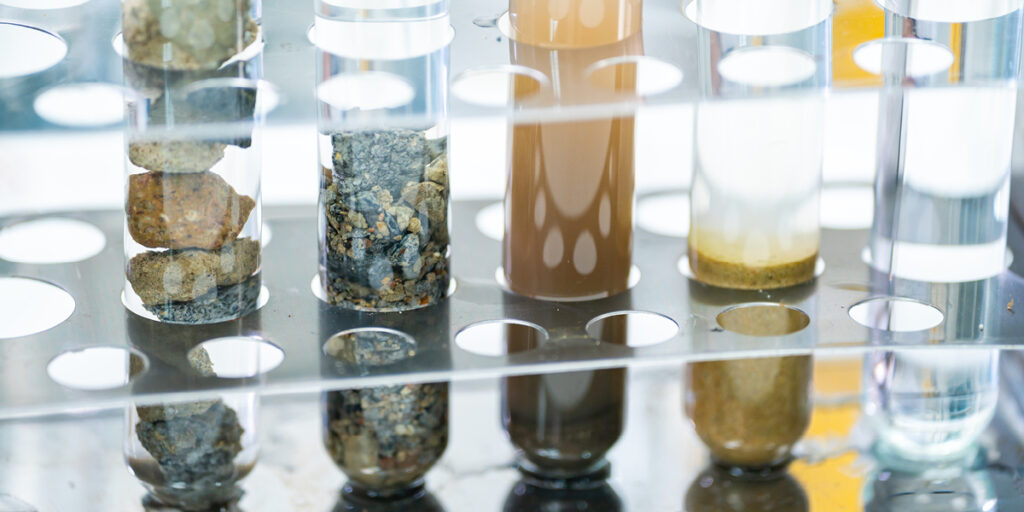
In the high-stakes world of modern mining, the line between a profitable venture and a missed opportunity is thinner than ever. As high-grade ore deposits become harder to find, the industry is turning its attention to lower-grade materials and the vast potential of tailings reclamation. In this environment, the laboratory is no longer just a support service; it is the engine room of economic viability. When you are quantifying trace metals at ultra-low levels, even a microscopic speck of environmental dust can skew your data, potentially leading to false positives or masking the true value of a mineral deposit.


The mystery of the rising “Blanks”

If you’ve ever sat in front of your workstation wondering why your Blank and Background Equivalent Concentration (BEC) values are stubbornly high, you aren’t alone. It is a common frustration for geochemical analysts: your instrument is calibrated, your reagents are fresh, yet the background noise refuses to quieten down. These elevated values aren’t just technical nuisances; they directly impair your Limit of Quantification (LOQ). In a world where a $0.1\text{ g/t}$ difference in a gold tailings project can determine financial success, “noisy” data is a risk you cannot afford to take.


Understanding the noise: BEC and LOQ

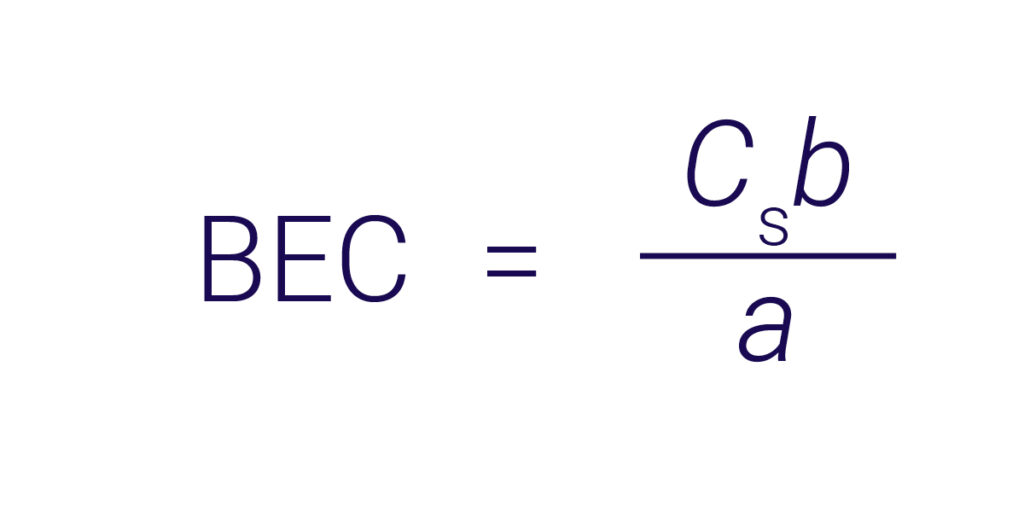
To solve the problem, we first have to understand it. The BEC represents the total background signal of your analytical system – essentially the “noise” the instrument sees when no sample is present. When this noise is high, your instrument struggles to distinguish a genuine analyte signal from the background. This directly pushes up your LOQ, making it impossible to accurately quantify the lower concentrations that modern mining exploration demands. The root cause of these high values? It usually comes down to one single, persistent word: CONTAMINATION.


Clean up your act with expert training and standards

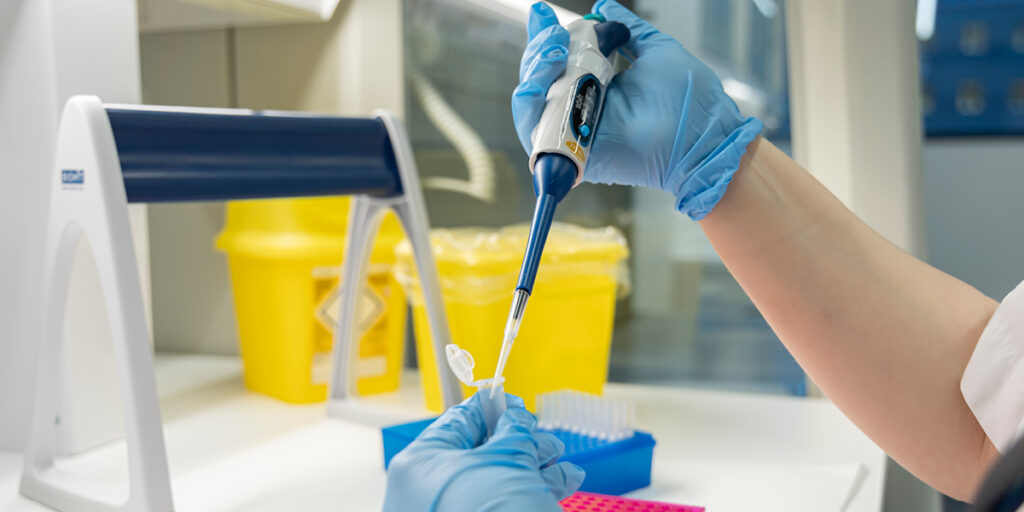
If your sample preparation isn’t meticulous, even the most advanced mass spectrometer will produce compromised results. Contamination is a silent thief that enters your workflow through water purity, reagent quality, and even the laboratory personnel themselves – common culprits include cosmetics, jewellery, and the powder in traditional gloves.


The Chemetrix Edge: We don’t just supply tools; we build expertise. Through the Chemetrix Lab Advisor, we provide your team with the specialised skills needed to identify and eliminate these “time traps”. By pairing this training with high-purity Inorganic Ventures Certified Reference Materials (CRMs), you ensure your calibration is built on a foundation of absolute purity.


Practical advice:

  • Stop the “Double-dip”: Never pipette directly from the stock bottle; transfer your working volumes into clean, secondary containers like pre-rinsed LDPE bottles.
  • Go gravimetric: Switch to weight-based (gravimetric) preparation. Mass doesn’t change with temperature, whereas volume does, leading to more reproducible and auditable results.


Technology that does the heavy lifting

While a clean bench is vital, the right hardware can act as your final line of defence against complex mineral matrices. Mining ores are notorious for their high levels of dissolved solids, which traditionally require extensive manual dilution – a process that introduces even more opportunities for human error and contamination.


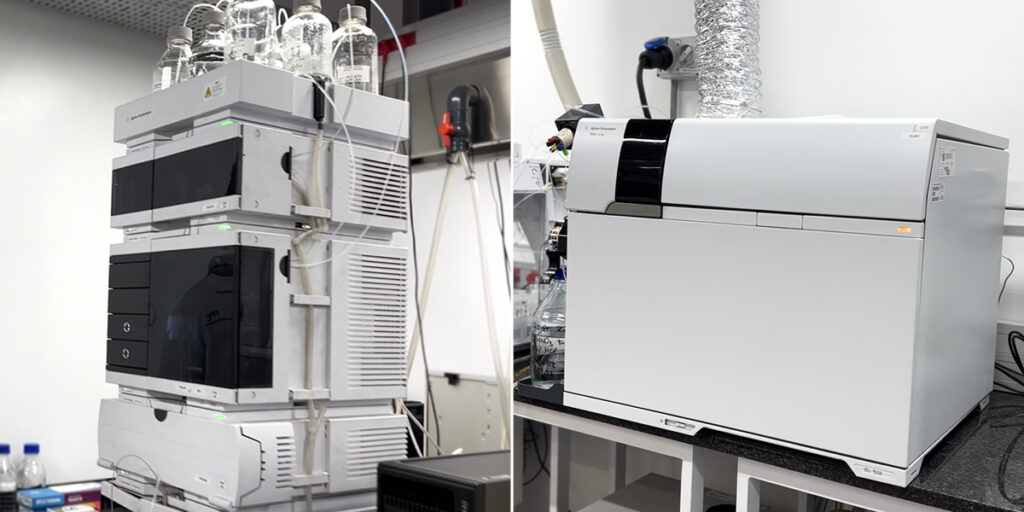
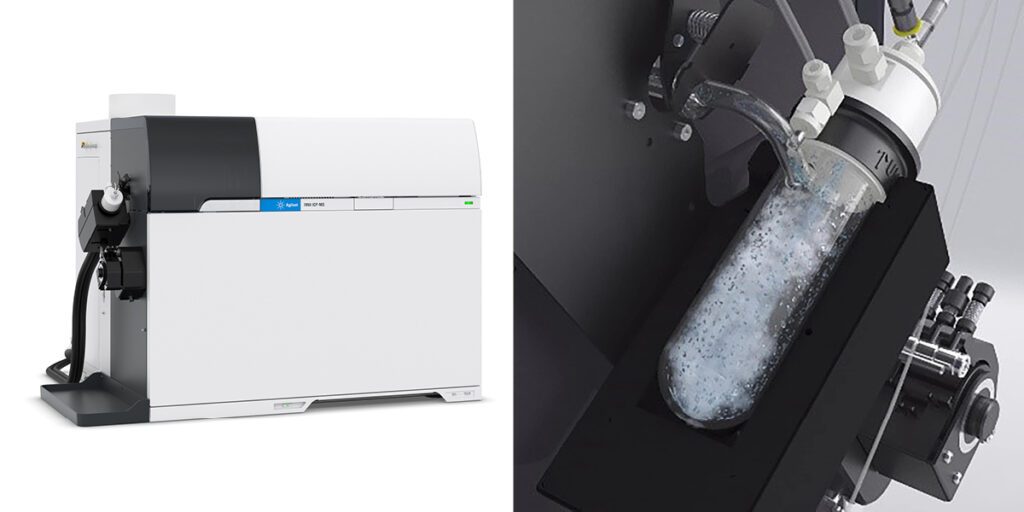
The Chemetrix Edge: We recommend the Agilent 7850 / 7900 / 8900 ICP-MS series as the physical solution to these high-matrix challenges. These instruments are equipped with Ultra High Matrix Introduction (UHMI) technology, which uses clean Argon gas to “dilute” your sample aerosol before it even reaches the plasma.


Practical advice:

By using the Agilent 7850’s UHMI system, your lab can directly analyse samples containing up to $25\%$ total dissolved solids without manual liquid dilution. This not only saves hours of labour but practically eliminates the risk of dilution errors and reagent-born contamination.


From waste to wealth: The reward of precision

The ultimate goal of refining your workflow is simple: lower LOQs and higher confidence. When you master your contamination control, you unlock the ability to see value where others see waste. Successful tailings reclamation depends on this precision. By accurately monitoring recovery at trace levels, mining operations can turn legacy liabilities into profitable resources, contributing to a more sustainable and circular mining economy.


Take the next step towards cleaner data

Ready to lower your detection limits and boost your lab’s productivity? It starts with a partnership that understands your specific challenges.

Review your prep: Identify one source of potential contamination today (check those gloves!)

Audit your standards: Ensure your CRMs are matrix-matched to your ores for better accuracy.

Connect with Chemetrix: Let our team of scientists help you tailor a solution that combines Agilent’s world-class technology with practical, on-the-ground support.

Let’s advance science together. Contact Chemetrix today to explore how we can elevate your laboratory’s performance.

How to Achieve 2-Minute Toxic Element Analysis with Integrated HPLC-ICP-MS

When regulatory limits for toxic elements in food keep getting stricter, labs face an uncomfortable reality: the methods they’ve relied on for years might not be fast enough or sensitive enough anymore. Analysis times stretching beyond 10 minutes per sample create bottlenecks. Coupling different instruments feels risky. And when your lab is responsible for detecting inorganic arsenic in baby food or cadmium in rice, there’s no room for error.

Here’s what most food testing labs don’t realise: the perceived complexity of coupling HPLC to ICP-MS is largely a myth. With the right hardware and software integration, what seems like a daunting technical challenge becomes a routine workflow that delivers results in under two minutes per sample.

The daily pressure of food safety testing

Walk into any food testing laboratory and you’ll hear the same concerns. Analysts are under pressure to process more samples with the same resources. Method development feels like reinventing the wheel for every new matrix. And when regulatory bodies lower action levels for toxic elements, labs scramble to validate new methods while maintaining daily sample throughput.

The real frustration? Many analysts believe that analysing inorganic arsenic, cadmium, lead and mercury requires complicated instrument coupling that only specialists can handle. They’ve heard that HPLC-ICP-MS is temperamental. They worry about stability over long sequences. They’re concerned that different vendors’ systems won’t communicate properly.These concerns create dangerous hesitation. Labs stick with older, slower methods because they’re familiar, even when those methods can’t meet new regulatory requirements. Sample backlogs grow. Turnaround times stretch.

The bottleneck isn’t the science. It’s the assumption that the solution has to be complicated.

Why toxic element speciation matters

Not all arsenic is created equal. Total arsenic measurements tell you how much is present, but they don’t tell you the critical part: is it toxic? Inorganic arsenic (the sum of arsenite As(III) and arsenate As(V)) is significantly more toxic than organic arsenic compounds like arsenobetaine found naturally in seafood. This is why regulations specify limits for inorganic arsenic rather than total arsenic. A rice cereal might contain arsenic, but if it’s all organic forms, the health risk is minimal. If it’s inorganic arsenic, even at low concentrations, it poses a developmental risk
to infants.

The same principle applies to other toxic elements. Cadmium accumulates in rice grown in contaminated soil. Lead and mercury, even at trace levels, affect neurological development in children. The US House of Representatives report in February 2021 found that many baby foods sold in supermarkets contained unacceptably high concentrations of these elements.

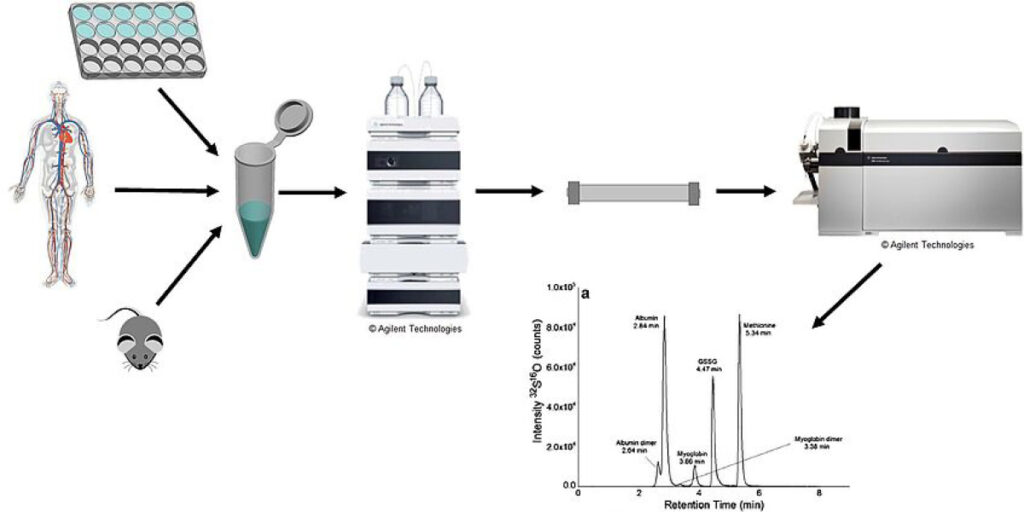
This is where speciation analysis becomes critical. HPLC separates different chemical forms of arsenic before ICP-MS detects them. By oxidising As(III) to As(V) during sample preparation, the analysis simplifies to measuring one peak representing total inorganic arsenic. The chromatographic separation happens in under two minutes, the ICP-MS provides sensitivity down to parts per billion and labs can confidently determine whether a food product meets regulatory limits.Food testing labs aren’t just generating data. They’re protecting the most vulnerable consumers: babies, infants and young children whose developing bodies are most susceptible to toxic element exposure.


Image credit: Institut für Analytische Chemie Universität Wien

The integration that changes everything

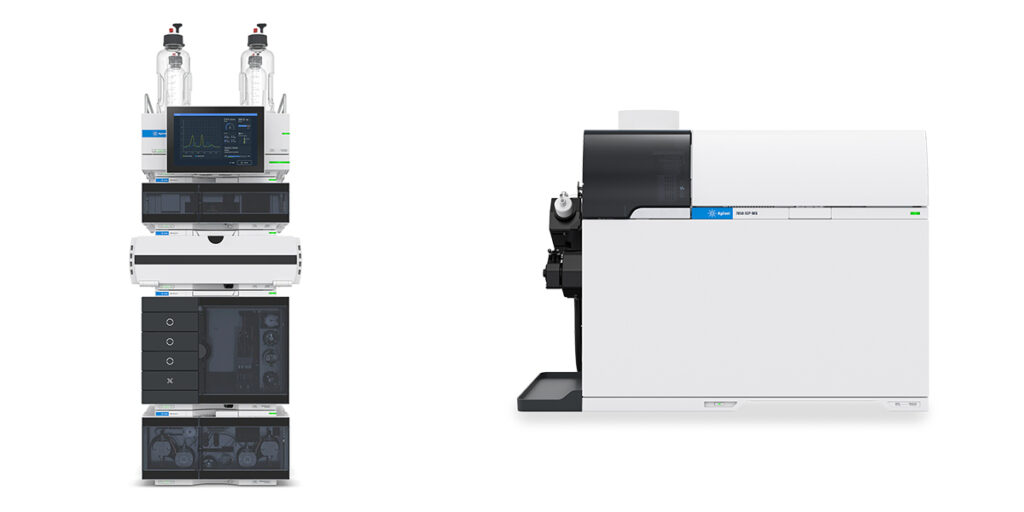
The breakthrough isn’t in the HPLC or the ICP-MS individually. Both instruments are well known in the industry for performance and robustness. The efficiency gain comes from how they work together. Agilent developed an optimised interface that physically couples the Agilent 1260 Inifinity III HPLC to both the 8900 ICP-QQQ and 7850 ICP-MS systems. But the real innovation is software integration. The entire coupled system is set up and operated from the ICP-MS MassHunter software. One interface. One method. Automated analysis.

Single software control means analysts don’t toggle between platforms or manually synchronise instrument parameters. Method development happens in one place.

Stable hardware coupling removes the guesswork from connecting instruments. The optimised interface ensures consistent sample transfer without leaks, dead volume or carryover issues.

Reduced setup time transforms HPLC-ICP-MS from a specialist technique into a routine capability. Labs new to speciation analysis can implement the method without extensive troubleshooting.

Fast 2-minute runs change the economics of compliance testing. When analysing inorganic arsenic requires 10+ minutes per sample using conventional columns, labs face real capacity constraints. At 2 minutes per sample, the same instrument processes five times the volume.

The 7850 ICP-MS adds practical features that matter for real-world food matrices. Ultra High Matrix Introduction (UHMI) handles samples with high dissolved solids without constant maintenance. The IntelliQuant function provides instant visibility into total matrix composition. And helium collision mode addresses spectral interferences without complex method optimisation.

Food safety compliance made routine

The US Baby Food Safety Act 2021 proposes maximum levels of 10-15 ppb inorganic arsenic depending on whether products are cereal-based. The FDA’s Closer to Zero plan phases in action levels for lead, arsenic, cadmium and mercury through 2024 and beyond. EU regulations specify limits for inorganic arsenic in rice between 0.1-0.3 mg/kg.

These aren’t aspirational targets. They’re enforceable limits that require labs to deliver accurate, defensible results.

The Agilent 1260 HPLC coupled to the Agilent 8900 ICP-QQQ provides the sensitivity and speed food testing labs need. The 8900 offers detection limits of 1.99 µg/kg for solid samples and 0.08 µg/L for liquid samples, well below regulatory action levels. The method complies with FDA Elemental Analysis Manual sections 4.7 and 4.11, as well as European standards EN16802:2016 and prEN17374:2019.

Real-world validation across baby foods, rice cereals, beverages and animal feed demonstrates recoveries between 82-111% with precision from 0.3-9.4% RSD.

📚 LEARN MORE: Application Note: Analysis of Inorganic Arsenic, Cadmium, Lead and Mercury in Baby Foods by ICP-MS (5994-3713EN)

Agilent 1260 Infinity III LC System

Agilent 7850 ICP-MS

High-throughput screening for production environments

Food manufacturers testing ingredients before use or finished products before release face a different challenge. They need screening capability that keeps pace with production schedules. Samples can’t wait days for results. Backlogs mean inventory sitting in quarantine.

The Agilent 1260 HPLC coupled to the Agilent 7850 ICP-MS delivers the throughput production labs require. The 7850 combines proven hardware with software features that simplify workflow for analysts who may be new to ICP-MS or new to Agilent systems. The 7850’s 10 orders of magnitude linear dynamic range means major and trace analytes are measured in a single run. No over-range failures. No sample reruns. The system processes samples with per cent-level total dissolved solids thanks to UHMI technology as standard.

For inorganic arsenic screening in rice cereals, the fast HPLC-ICP-MS method reduces analysis time from over 10 minutes to under 2 minutes. The short anion exchange column, optimised mobile phase and small injection volumes maintain baseline separation of inorganic arsenic from organic species without compromising resolution.

Empowering labs, not overwhelming them

There’s a pervasive mindset in many labs that complexity is just part of the job. That coupling instruments will always be difficult. That fast methods sacrifice accuracy. That meeting new regulatory limits requires hiring specialists or sending samples to reference labs.

Chemetrix rejects this narrative. Labs shouldn’t have to choose between speed and accuracy. They shouldn’t accept that advanced techniques are only accessible to experts. And they absolutely shouldn’t operate under the assumption that their current capabilities define their future possibilities.

This is where partnership matters. Chemetrix doesn’t just supply instruments. We advocate for a scientific culture grounded in integrity, accuracy and respect for the people doing the work. When we say the Agilent HPLC-ICP-MS coupling is easier than labs think, we’re not minimising the science. We’re affirming that with the right tools and support, routine labs can deliver extraordinary results.

The optimised interface, integrated software control and proven application methods aren’t just technical specifications. They’re a commitment to removing barriers between labs and the capabilities they need.

Conclusion

Toxic element analysis in food doesn’t have to be the bottleneck in your lab. The perceived complexity of HPLC-ICP-MS coupling dissolves when hardware and software are designed to work together from the start.


Ready to transform your toxic element analysis workflow?

Download the application notes for baby food and rice cereal analysis to see validated methods and real-world results. Contact Chemetrix to discuss how fast HPLC-ICP-MS screening can eliminate testing bottlenecks in your facility.

Food safety depends on labs that can deliver accurate results quickly. With the right partnership and the right tools, your lab can be exactly that kind of asset.

Contact Chemetrix today to discuss your toxic element analysis challenges and discover solutions designed for your reality.


✅ TL;DR – Key Takeaways

  • HPLC-ICP-MS coupling is simpler than most labs assume when using integrated Agilent systems
  • 2-minute analysis times for inorganic arsenic deliver 5x throughput vs conventional methods
  • Detection limits well below regulatory action levels ensure compliance confidence
  • Single software control reduces setup complexity and streamlines daily operation

Jet Fuel by ICP-MS

The measurement of trace metals in petroleum feeds and its derivatives provides vital information required for running sustainable and daily petroleum operations around the world. Inductively Coupled Plasma Mass Spectrometry (ICP-MS) is used in different petroleum facilities due to its ability to perform multi-element analyses, covering a broad range of concentrations as well as being robust and reliable. ICP-MS is becoming more integrated into petroleum laboratories due to its maturity and versatility.

This talk will cover Agilent’s efforts towards developing an ASTM Jet Fuel method. Many interesting elements that aren’t commonly requested, including Platinum (Pt) and Palladium (Pd), will be discussed with this new ICP-MS method. Preliminary data from the ASTM pilot study will be shared in this talk.


Speakers

Jenny Nelson, PhD
Application Scientist
Agilent Technologies, Inc.


Mark Kelinske
Application Scientist
Agilent Technologies, Inc.


Register and watch on demand >


Avoiding Common Time Traps in ICP-MS Analysis: A Virtual Workshop

Inductively coupled plasma–mass spectrometry (ICP-MS) is a fast, multielement technique used for trace elemental analysis.

But labs that use ICP-MS – or are thinking of installing one – can find it difficult to unlock the true potential of the technique. Unproductive and often unnecessary activities can eat into lab time, reducing productivity, increasing stress, and potentially impacting data quality. Open to all; this workshop will provide insights you can employ to improve efficiency in your laboratory while also reducing pressure on staff and increasing confidence in the results you report.


Speakers

Bert Woods
Application Scientist
Agilent Technologies, Inc.

Joined the Agilent ICP-MS team in 2004, with previous employment in the semiconductor industry with Dominion Semiconductor (IBM/Toshiba) and Micron. Bert is a 1997 Chemistry graduate of Radford University in Virginia and an avid Washington DC Sports fan.


L. Craig Jones
ICP-MS Application Scientist
Agilent Technologies, Inc.

Craig has been with Agilent for over 15 years as an ICP-MS applications scientist. He has been involved with multiple types of applications for ICP-MS, including environmental, pharmaceutical, nutraceutical, semiconductor, geologic, and clinical analyses, to name a few. Previous to Agilent, he worked in an environmental lab performing analysis and supervising both the inorganic and organic sections of the laboratory. In his spare time, Craig enjoys volunteering at the local marine science centre, mountain biking, hiking and relaxing at the beach. Craig obtained a bachelor of science degree in chemistry from Fort Lewis College in Durango, CO.


Register and watch on demand >


Food and Cannabis Elemental Analysis Part 2: Elemental Sample Prep for the Food and Agriculture Lab – Optimizing Your System for High Matrix Samples

Trace elemental analysis of foods and cannabis products is essential to ensure that products are suitable for consumption. The analysis of minerals and additional trace elements is also important because it provides labelling information that is required when these products are used as nutritional.

Agilent has presented a webinar series that focuses on elemental sample preparation to optimise high matrix samples in the food and agriculture testing space.


Part 1

We will cover the entire Agilent elemental portfolio. Each of the different instruments’ strengths and how they meet the challenges that food and cannabis labs have.


Part 2

We will focus on preparing your samples, including microwave digestion. We will also cover how to optimize your system for high matrix samples and a diverse sample set.


Part 3

We will put it all together, with running samples live in the lab. We will also share additional tips and tricks for obtaining excellent analytical results in these difficult matrices.

This focused information on spectroscopy applications is valuable for the emerging cannabis market as well as analysts who are seeking to master skills for food testing.


Speakers

Jenny Nelson, PhD
Application Scientist
Agilent Technologies, Inc.

Jenny Nelson received her Ph.D. in Analytical Chemistry from the University of Cincinnati in 2007, and her MBA from Saint Mary’s College of California in 2011. Currently, Jenny is an Application Scientist for the Life Science and Chemical Analysis team at Agilent Technologies, joining in 2012 (with a step away in 2019). Jenny is also an Adjunct Professor in the Department of Viticulture and Enology at the University of California, Davis, since 2013. Jenny has been very active with AOAC and ASTM over the past eight years, serving on expert review panels, chairing committees, and volunteering to develop new methods needed by the industry. Jenny has extensive experience in operating and method development for Inductively Coupled Plasma Mass Spectroscopy (ICP-MS), Inductively Coupled Plasma Optical Emission Spectroscopy (ICP-OES), Microwave Plasma Atomic Emission Spectroscopy (MP-AES). Jenny has broad knowledge and experience in different speciation analysis for many sample matrices using GC-ICPMS and LC-ICPMS. As well as vast experience with sp-ICP-MS for many applications.


Greg Gilleland
Application Scientist
Agilent Technologies, Inc.

Greg began his spectroscopy career in 1987 in Colorado, working at a series of environmental labs. After 14 years working in the world of commercial environmental labs, he moved on to a spectroscopy instrument manufacturer where he performed service and sales functions over the course of 11 years. He has been with Agilent Technologies, Inc., since 2012 in the role of Application Scientist for ICP-OES, MP-AES and AA products.


Mark Kelinske
Application Scientist
Agilent Technologies, Inc.

Mark Kelinske is an Applications Chemist with Agilent Technologies, specializing in advanced ICP-MS and ICP-MS/MS techniques. He received his undergraduate and graduate degrees from Texas A&M University in College Station, TX. Prior to Agilent, Mark was a senior research scientist and research group manager with Southern Research Institute in Birmingham, AL, where he focused on low-level analytical chemistry, method development, and research program management.


Chris Conklin
Atomic Spectroscopy Product Specialist
Agilent Technologies, Inc.

With a degree from the University of Wisconsin – Eau Claire, Chris worked in, and lead, a quality control lab testing fine chemicals ranging from reagent grade to high purity. Over the course of 12 years in that role, Chris has run a variety of atomic elemental instruments and techniques including AA, ICP-OES, and ICP-MS. As a result, he has seen most of the periodic table in its elemental form and overcome the associated interferences. In 2018, Chris brought that knowledge and experience to his current role with Agilent as the Product Specialist for Atomic Spectroscopy supporting AA, MP-AES, and ICP-OES for the Eastern US.


Register and watch on demand >


Knowing How to Make ICP-MS Easier

Knowing the right information at the right time can help you cut through the everyday complexities of your ICP-MS analysis.

Driven by insights from customers from around the world, Agilent has developed a range of Easy-fit supplies, intuitive yet powerful software and complete workflows to bring the confidence of knowing you will get the answers you need to efficiently run your lab.

Watch the presentation and learn how to make your ICP-MS applications easier to run, maintain and control.


What you will learn

  • Learn how our range of Easy-fit supplies can simplify your workflow
  • Discover our selection tools that can help you get your ICP-MS configured right for your analysis
  • Take a look at ICP-MS MassHunter software
  • Learn about some of the simple software tools and time-saving tips that can help you get the very best out of your ICP-MS.


Gareth Pearson
ICP-MS Supplies Product Manager (Agilent, Spectroscopy Technology Innovation Centre, Melbourne, Australia)

Angie is a proteomics scientist on the application team at Evosep BioSciences. Her work focuses on bringing standardization, throughput, and depth into translation proteomic research studies. During her PhD at University College Dublin studying proteomics in inflammatory arthritis and postdoc at Cedars Sinai, Los Angeles, Angie conducted large scale biomarker studies, where she gained considerable experience with the Evosep One and the Agilent triple quadrupole mass spectrometers.


Gareth Pearson
ICP-MS Supplies Product Manager (Agilent, Spectroscopy Technology Innovation Centre, Melbourne, Australia)

Angie is a proteomics scientist on the application team at Evosep BioSciences. Her work focuses on bringing standardization, throughput, and depth into translation proteomic research studies. During her PhD at University College Dublin studying proteomics in inflammatory arthritis and postdoc at Cedars Sinai, Los Angeles, Angie conducted large scale biomarker studies, where she gained considerable experience with the Evosep One and the Agilent triple quadrupole mass spectrometers.


Gareth Pearson
ICP-MS Supplies Product Manager (Agilent, Spectroscopy Technology Innovation Centre, Melbourne, Australia)

Angie is a proteomics scientist on the application team at Evosep BioSciences. Her work focuses on bringing standardization, throughput, and depth into translation proteomic research studies. During her PhD at University College Dublin studying proteomics in inflammatory arthritis and postdoc at Cedars Sinai, Los Angeles, Angie conducted large scale biomarker studies, where she gained considerable experience with the Evosep One and the Agilent triple quadrupole mass spectrometers.


Register and watch on demand >


Food and Cannabis Elemental Analysis Part 3: Elemental Analysis, Putting it All Together – Agilent 7850 ICP-OMS with MassHunter 5.1 Live Demo & Agilent 5900 ICP-OES with ICP Expert Live Demo

This will be a three week Food and Cannabis elemental analysis workshop. We will cover a lot of great information during these three weeks.

Part 3: We will put it all together, with running samples live in the lab.  We will also share additional tips and tricks on obtaining excellent analytical results in these difficult matrices.


Speakers

Jenny Nelson, PhD, Application Scientist, Agilent Technologies, Inc.

Jenny Nelson received her Ph.D. in Analytical Chemistry from the University of Cincinnati in 2007, and her MBA from Saint Mary’s College of California in 2011. Currently, Jenny is an Application Scientist for the Life Science and Chemical Analysis team at Agilent Technologies, joining in 2012 (with a step away in 2019). Jenny is also an Adjunct Professor in the Department of Viticulture and Enology at the University of California, Davis, since 2013. Jenny has been very active with AOAC and ASTM over the past eight years, serving on expert review panels, chairing committees, and volunteering to develop new methods needed by the industry. Jenny has extensive experience in operating and method development for Inductively Coupled Plasma Mass Spectroscopy (ICP-MS), Inductively Coupled Plasma Optical Emission Spectroscopy (ICP-OES), Microwave Plasma Atomic Emission Spectroscopy (MP-AES). Jenny has broad knowledge and experience in different speciation analysis for many sample matrices using GC-ICPMS and LC-ICPMS. As well as vast experience with sp-ICP-MS for many applications.

Greg Gilleland, Application Scientist, Agilent Technologies, Inc.

Greg began his spectroscopy career in 1987 in Colorado, working at a series of environmental labs. After 14 years working in the world of commercial environmental labs, he moved on to a spectroscopy instrument manufacturer where he performed service and sales functions over the course of 11 years. He has been with Agilent Technologies, Inc., since 2012 in the role of Application Scientist for ICP-OES, MP-AES and AA products.

Mark Kelinske, Application Scientist, Agilent Technologies, Inc.

Mark Kelinske is an Applications Chemist with Agilent Technologies, specializing in advanced ICP-MS and ICP-MS/MS techniques. He received his undergraduate and graduate degrees from Texas A&M University in College Station, TX. Prior to Agilent, Mark was a senior research scientist and research group manager with Southern Research Institute in Birmingham, AL, where he focused on low-level analytical chemistry, method development, and research program management.

Chris Conklin, Atomic Spectroscopy Product Specialist, Agilent Technologies, Inc.

With a degree from the University of Wisconsin – Eau Claire, Chris worked in, and lead, a quality control lab testing fine chemicals ranging from reagent grade to high purity. Over the course of 12 years in that role, Chris has run a variety of atomic elemental instruments and techniques including AA, ICP-OES, and ICP-MS. As a result, he has seen most of the periodic table in its elemental form and overcome the associated interferences. In 2018, Chris brought that knowledge and experience to his current role with Agilent as the Product Specialist for Atomic Spectroscopy supporting AA, MP-AES, and ICP-OES for the Eastern US.


Register Here >


Food and Cannabis Elemental Analysis Part 1: Elemental Workflows in the Food and Cannabis Lab

This will be a three week Food and Cannabis elemental analysis workshop. We will cover a lot of great information during these three weeks.

Part 1: We will cover the entire Agilent elemental portfolio. Each of the different instruments’ strengths and how they meet the challenges that food and cannabis labs have.


Speakers

Jenny Nelson, PhD, Application Scientist, Agilent Technologies, Inc.

Jenny Nelson received her Ph.D. in Analytical Chemistry from the University of Cincinnati in 2007, and her MBA from Saint Mary’s College of California in 2011. Currently, Jenny is an Application Scientist for the Life Science and Chemical Analysis team at Agilent Technologies, joining in 2012 (with a step away in 2019). Jenny is also an Adjunct Professor in the Department of Viticulture and Enology at the University of California, Davis, since 2013. Jenny has been very active with AOAC and ASTM over the past eight years, serving on expert review panels, chairing committees, and volunteering to develop new methods needed by the industry. Jenny has extensive experience in operating and method development for Inductively Coupled Plasma Mass Spectroscopy (ICP-MS), Inductively Coupled Plasma Optical Emission Spectroscopy (ICP-OES), Microwave Plasma Atomic Emission Spectroscopy (MP-AES). Jenny has broad knowledge and experience in different speciation analysis for many sample matrices using GC-ICPMS and LC-ICPMS. As well as vast experience with sp-ICP-MS for many applications.

Greg Gilleland, Application Scientist, Agilent Technologies, Inc.

Greg began his spectroscopy career in 1987 in Colorado, working at a series of environmental labs. After 14 years working in the world of commercial environmental labs, he moved on to a spectroscopy instrument manufacturer where he performed service and sales functions over the course of 11 years. He has been with Agilent Technologies, Inc., since 2012 in the role of Application Scientist for ICP-OES, MP-AES and AA products.

Mark Kelinske, Application Scientist, Agilent Technologies, Inc.

Mark Kelinske is an Applications Chemist with Agilent Technologies, specializing in advanced ICP-MS and ICP-MS/MS techniques. He received his undergraduate and graduate degrees from Texas A&M University in College Station, TX. Prior to Agilent, Mark was a senior research scientist and research group manager with Southern Research Institute in Birmingham, AL, where he focused on low-level analytical chemistry, method development, and research program management.

Chris Conklin, Atomic Spectroscopy Product Specialist, Agilent Technologies, Inc.

With a degree from the University of Wisconsin – Eau Claire, Chris worked in, and lead, a quality control lab testing fine chemicals ranging from reagent grade to high purity. Over the course of 12 years in that role, Chris has run a variety of atomic elemental instruments and techniques including AA, ICP-OES, and ICP-MS. As a result, he has seen most of the periodic table in its elemental form and overcome the associated interferences. In 2018, Chris brought that knowledge and experience to his current role with Agilent as the Product Specialist for Atomic Spectroscopy supporting AA, MP-AES, and ICP-OES for the Eastern US.


Register Here >