

There is a particular kind of silence in a pharmaceutical audit that every QA manager knows. It is not the silence of a clean room or an empty corridor. It is the silence after an inspector closes a data file, looks up and says nothing because everything is in order. That silence is the goal. And in elemental impurity testing, it is harder to achieve than most labs expect.
ICH Q3D and USP chapters 232 and 233 set mandatory limits for elemental impurities in pharmaceutical products. Compliance is not discretionary. It is not a best practice recommendation. It is a regulatory requirement that applies to every oral and parenteral drug product on the market. The question is not whether your lab will comply, but whether your workflow can prove it, consistently, at trace levels, across every batch, under inspection.
This article explains where most labs stall, why the problem is almost always a process issue rather than a hardware issue, and how a validated ICP-MS workflow built on the right instrumentation and partnership gives you the audit confidence you need.

Elemental impurities are unwanted inorganic elements that enter pharmaceutical products through raw materials, metal catalysts used in synthesis, manufacturing equipment or packaging. They include Class 1 elements such as arsenic, cadmium, lead and mercury, which carry the highest toxicological risk, through to Class 2 and Class 3 elements with route-specific exposure limits. None of them belong in a finished drug product above their permissible daily exposure levels, and none of them are detectable by visual inspection, smell or conventional wet chemistry.
This is what makes a compliance failure in this category so damaging. By the time a contamination event is discovered, product has often already been distributed. The financial cost of a recall is significant. The cost to patient trust is permanent. And because elemental impurities at toxic concentrations produce no visible sign of product degradation, the only defence is a validated analytical method that catches them before the product leaves the facility.
The pressure is continuous. Batch testing is not a one-time validation exercise. It is a routine, recurring obligation that runs for the entire commercial life of the product. Every batch. Every route of administration. Every manufacturing site change. The workflow that handles this cannot be fragile, analyst-dependent or difficult to defend under scrutiny.
ICH Q3D is the international harmonised guideline for elemental impurities in pharmaceutical products. It is adopted by the US Food and Drug Administration, the European Medicines Agency, Japan’s Pharmaceuticals and Medical Devices Agency and other global regulatory bodies. It establishes permissible daily exposure limits for a defined set of elemental impurities across oral and parenteral administration routes.
USP chapter 232 sets the acceptance criteria, defining the specific concentration limits for each element by route of administration. USP chapter 233 defines the analytical procedures required to demonstrate compliance, including the method validation parameters of specificity, linearity, accuracy, precision and detection limits.
The analytical techniques specified under USP 233 for elemental impurity analysis are ICP-MS and ICP-OES. These are the techniques that provide the ideal capabilities for determining inorganic contaminants to ICH Q3D and USP 233 requirements. Between the two, ICP-MS is the instrument of choice for most pharmaceutical laboratories, offering superior sensitivity at trace and ultra-trace concentration levels across the full range of regulated elements. ICP-OES is well suited to elements present at higher concentrations and to laboratories where the breadth of the ICP-MS dynamic range is not required for every element in scope.
Together, ICH Q3D, USP 232 and USP 233 define not just what must be measured, but how the measurement must be proven to work and on which platform. The regulatory framework is specific. The instrumentation it points to is equally specific.

The Chemetrix team consistently identifies method validation as the point where pharmaceutical labs stall. Not instrument performance.
Not detection capability. Method validation.
The leap from early-stage R&D profiling, where the goal is elemental detection and characterisation, to validated routine QC, where the goal is defensible batch release data, is significant. In R&D, an analyst runs a method, gets a result and moves on. In QC, that same method must be formally validated, transferred to a different instrument or operator, proven robust across variations in sample matrix and demonstrated to remain fit for purpose over time.
This is where the human and process variables multiply. Instrument-to-instrument method transfer introduces drift. Analyst-to-analyst variability in sample preparation introduces inconsistency. Calibration standard preparation from single-element solutions introduces calculation errors and traceability gaps. Any one of these variables can generate an audit finding, not because the underlying science was wrong, but because the documentation did not adequately capture what was done and why.
The calibration standard problem deserves particular attention. Preparing ICP-MS calibration solutions for a multi-element elemental impurity method from individual single-element stock solutions is time-consuming, error-prone and difficult to trace. A single pipetting error, an incorrect dilution factor or a matrix mismatch between the standard and the sample can compromise the entire run. In a routine QC environment running batch after batch, these risks compound over time.
Chemetrix Insight: “In ICP-MS-based elemental impurity testing, the strongest flagship is not the data. It is the defensibility of that data.”
The answer is to remove as many human variables as possible before the method reaches routine QC. For ICP-MS elemental impurity workflows, this starts with the reference materials.
Agilent’s ICH Q3D/USP 233 Elemental Impurities Portfolio does exactly this. The portfolio includes certified reference material kits for both oral and parenteral routes, with elements sorted by ICH and USP class, chemical compatibility and relative mandated concentrations.
This design eliminates the need for analysts to prepare their own calibration standards from single-element solutions, removing the most significant source of human error in the ICP-MS calibration workflow. Instead of calculating and preparing multi-element mixes from scratch, analysts work from pre-formulated, ready-to-use solutions that are already matched to the permissible daily exposure levels required by the method.
The kits are manufactured in an ISO 17034-accredited facility and certified in an ISO/IEC 17025 testing laboratory. Each kit is supplied with a Certificate of Analysis confirming actual concentrations, measurement uncertainty and NIST traceability. A dedicated Pharma Internal Standard Solution is included, optimised specifically for ICP-MS and ICP-OES results with common pharmaceutical sample types, which is critical for accurate internal standardisation across the wide mass range covered by a full USP 232/233 elemental panel.
Agilent has also updated these kits to reflect the most recent USP 232 guideline changes, which increased the permissible limits for gold and silver. Using current, regulatory-aligned certified reference materials is a fundamental audit requirement and one that is easily overlooked when laboratories are managing their own standard preparation programmes.
Agilent ICP-MS and ICP-OES platforms include preset methods built specifically for ICH Q3D and USP 232/233 compliance. This reduces the configuration burden during method transfer from R&D to QC and provides a validated starting point that is consistent across instruments, reducing the risk of method drift between sites
or between analysts.
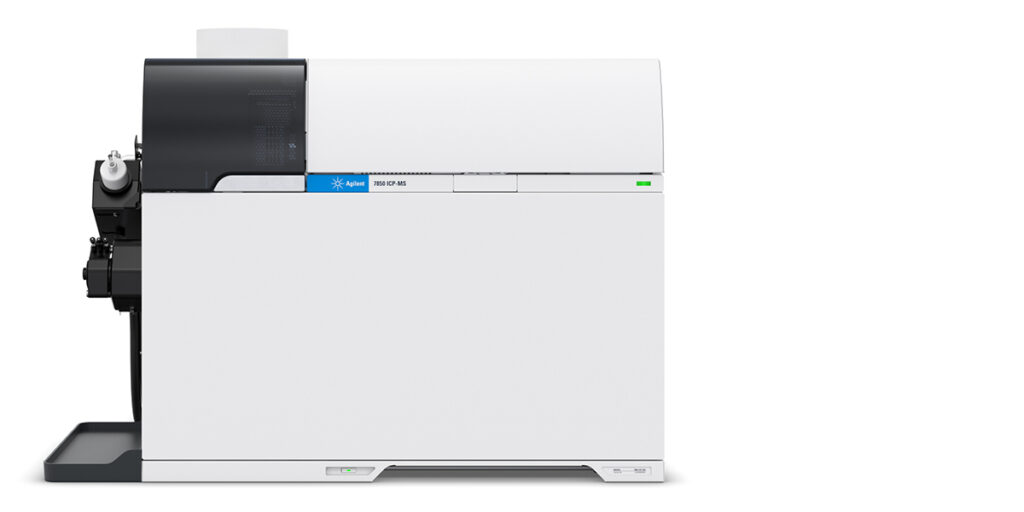
The ICP-MS is the primary instrument for pharmaceutical elemental impurity testing because the regulatory requirements demand it. USP 233 specifies trace-level multi-element analysis across a wide range of elemental classes with strict accuracy and precision requirements.
ICP-MS is uniquely suited to this task, offering the sensitivity, selectivity and multi-element capability that the method demands.
For pharmaceutical applications specifically, the combination of the Agilent ICP-MS platform with the ICH Q3D/USP 233 certified reference material kits creates a complete, traceable, regulation-aligned solution. The oral kit covers the full panel of elements required for oral drug product release. The parenteral kit addresses the tighter permissible daily exposure limits applicable to injectable and infusion products, where the regulatory scrutiny is highest.
The Agilent ICP-OES platform extends this capability to elements present at higher concentration ranges, and provides a complementary option for laboratories where the full sensitivity range of ICP-MS is not required for every element in scope. For many pharmaceutical laboratories, ICP-MS and ICP-OES are used together to cover the complete elemental panel efficiently.
Agilent’s OpenLAB Software Suite supports data management and analysis across the ICP-MS and ICP-OES platforms, maintaining the data integrity and audit trail controls required in a regulated pharmaceutical environment. Analytical Instrument Qualification and Functional Verification services are available from Agilent to support regulatory submissions and inspection readiness, ensuring that the instrument performing the analysis is as well-documented as the method itself.
📌 Ask Chemetrix about configuring a complete ICP-MS elemental impurity compliance workflow, including reference materials, method setup and instrument qualification.

Supplying an Agilent ICP-MS system is the beginning of the story, not the end. The instrument is capable. Whether the workflow built around it is defensible under inspection is a different question entirely, and it is the question that Chemetrix answers.
Too many labs reach the method validation wall and stall there. They have the instrument. They have the regulatory guidance. But the gap between a working ICP-MS method and a validated, documented, transferable method that survives an audit is wider than most labs anticipate when they start the project.
Compliance is mandatory. The data alone is not enough.
It is the documented, traceable, reproducible system behind the data that gives regulators confidence and gives patients the protection they are owed.

Elemental impurity compliance under ICH Q3D and USP 232/233 is one of the most technically demanding and most consequential analytical obligations in pharmaceutical manufacturing. The stakes are patient safety. The standard is mandatory. And the challenge is not the sensitivity of the ICP-MS. It is the defensibility of the workflow built around it.
The Agilent ICP-MS platform and certified reference material portfolio provide the instrumentation and standards. Chemetrix provides the validated workflow, the ongoing support and the audit-ready confidence that makes elemental impurity compliance continuous rather than periodic.
📩 Contact the Chemetrix team to discuss ICP-MS configuration, reference material selection or audit preparation for your elemental impurity programme: chemetrix.co.za

Chemetrix Export (Pty) Limited
400 - 16th Road
Block H Central Park
Midrand 1685


