

The batch is ready. The vessel looks clean. But the documentation is not done, the QC queue is backed up and the equipment has been sitting idle waiting on analytical results.
This is the real cost of a slow or uncertain cleaning validation programme. Not the cost of the instrument. Not the complexity of the method. The cost is measured in hours of lost production, delayed releases and the quiet anxiety of knowing that if an inspector walked in right now, your data trail would not tell a clear and convincing story.
Total organic carbon (TOC) analysis exists precisely to eliminate that anxiety. When implemented correctly, it is one of the fastest, most regulator-friendly, and most operationally practical cleaning verification methods available. This article explains why so many labs are not using it that way and what it takes to change that.
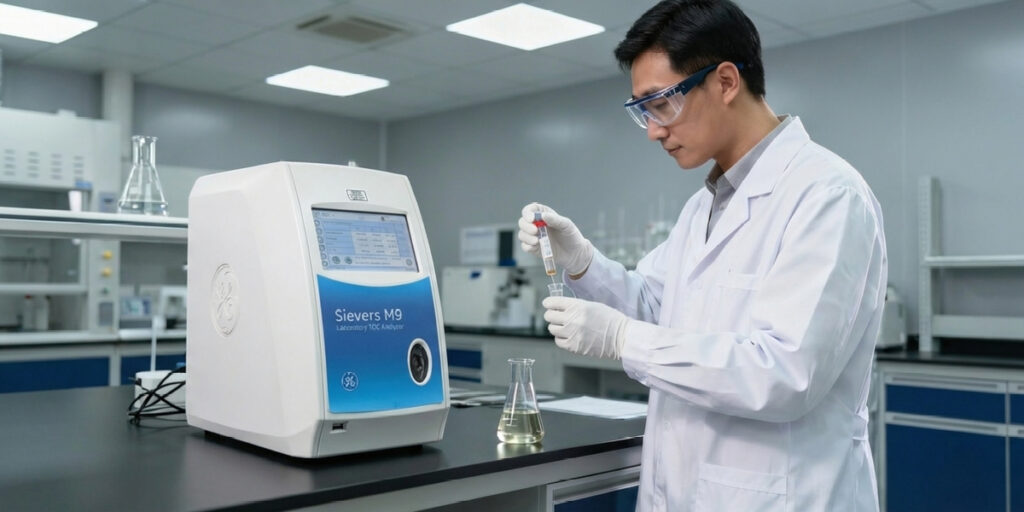
Most cleaning validation conversations start with the method. They should start with the consequence. A single failed clean in a pharmaceutical or food manufacturing facility does not just mean re-cleaning the vessel. It means halting production, quarantining potentially affected batches, initiating a deviation investigation, documenting the root cause, re-validating the cleaning cycle and demonstrating to QA that it will not happen again. In a worst-case scenario, that is days of downtime on a critical piece of manufacturing equipment.
The Chemetrix team has seen this play out in facilities relying on product-specific methods like HPLC for cleaning verification. When an unknown degradant or cleaning agent residue slips through undetected, the specific method offers no warning. TOC does. Because it measures the total organic carbon in a rinse or swab sample, it catches APIs, degradants, excipients and cleaning agents in a single analysis. There is no invisible contamination with a properly implemented TOC method.
The three most common operational pain points the Chemetrix team identifies in cleaning validation programmes are:
These are workflow problems. Not instrument problems.
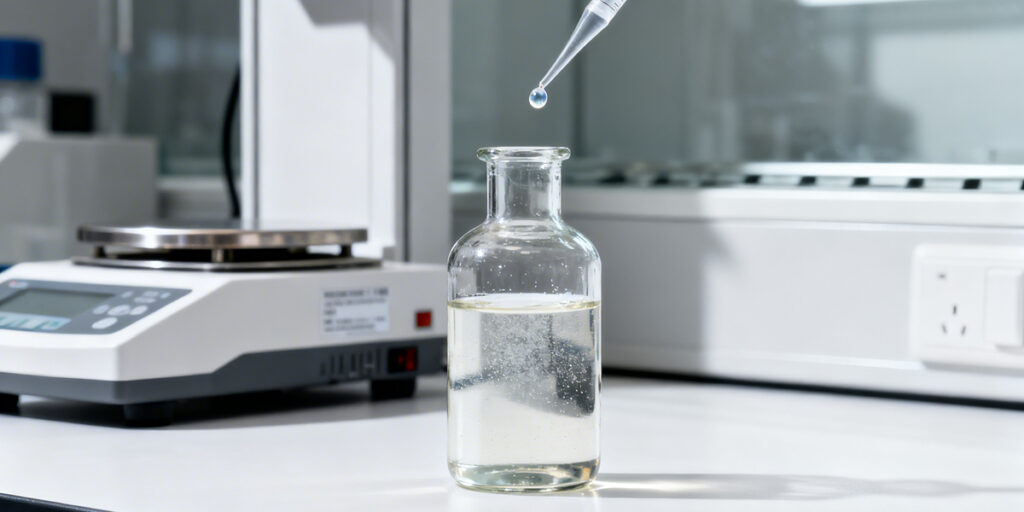
TOC analysis works by oxidising all organic residues in a sample and measuring the carbon dioxide produced. The result is a single, quantitative carbon concentration value that tells you, objectively, how much organic material remains on the equipment surface or in the final rinse.
This matters enormously in a regulated environment because it removes operator subjectivity from the result. There is no peak integration to argue about, no ghost peaks to investigate and no ambiguity about whether a signal is real or an artefact. The FDA has issued numerous warning letters specifically for HPLC data integrity failures, including failure to integrate peaks and inadequate investigation of unknown peaks. These problems are structurally unavoidable in product-specific methods because cleaning processes generate degradants and unexpected compounds that the specific method was never designed to detect.
TOC does not have this problem. It detects everything organic. That is not a liability. That is a feature. The regulatory acceptance of TOC for cleaning validation is well established. The US Pharmacopoeia, the US Food and Drug Administration and the European Medicines Agency all recognise TOC as an appropriate and compliant method for demonstrating equipment cleanliness. The FDA’s 2011 process validation guidance is particularly significant: the traditional practice of measuring a single API with a specific method is no longer considered compliant with FDA best practice, because it does not provide the process understanding the life cycle approach requires. TOC, as a non-specific method, measures both product-related and process-related residues as a function of carbon content, making it compliant with that guidance and giving a comprehensive view of cleanliness at every phase of the validation life cycle.
When sensitivity becomes a concern, it is worth reframing the question:
A TOC analyser is not too sensitive. It is appropriately sensitive. Sensitivity is exactly what guarantees that equipment is genuinely clean, not just clea
n enough to pass a method that was not looking for everything.

The short answer is yes – in most cases, TOC is more cost-effective than HPLC, often delivering noticeable savings within the first year of implementation.
HPLC for cleaning validation requires a separate, validated method for each product. Method development is time-consuming and assumes that all potential interferents are fully understood. It cannot detect degradants or cleaning agent residues that fall outside the target compound. Laboratory workflow typically means grab samples are transported to the QC lab, queued for analysis and results returned hours later. Equipment sits idle during this time.
TOC for cleaning validation requires a single method that covers APIs, excipients, degradants and cleaning agents simultaneously. The Sievers M9 delivers results in two minutes in standard mode, or four seconds with the optional Turbo mode. The M9 Portable model can be taken directly to the manufacturing floor, samples can be analysed almost immediately after collection and equipment can be released faster.
The economic gains compound over time. Fewer out-of-specification investigations due to environmental or transcription errors, faster analyst throughput, reduced re-testing and the elimination of mobile phase preparation all contribute to a meaningfully lower total cost of running a cleaning validation programme.
Chemetrix Insight: “TOC almost always reduces total validation costs within the first year by accelerating batch release and reducing the frequency of re-testing. The instrument cost is recovered faster than most labs expect.”

When TOC results are inconsistent or a cleaning validation programme is not delivering the confidence it should, the problem is almost never the analyser. Here is the hierarchy of where to look first.
Step 1: Check the water baseline. The carbon contribution of the rinse water itself must be established and controlled. If the water baseline is elevated or variable, every subsequent result will be unreliable. Low-TOC water and appropriate Sievers certified vials are the foundation of reproducible results.
Step 2: Review the swab technique. Analyst-to-analyst variability in swabbing is one of the most common sources of inconsistency in cleaning validation data. In published validation data using the Sievers M9, two different analysts achieved recovery values of 100% to 105.8% with RSD values below 2.1% for the same CIP-100 cleaning agent at multiple concentration levels, demonstrating that a well-standardised method is highly reproducible across operators. If your res
ults do not look like this, the method has not been standardised, not the instrument.
Step 3: Confirm the worst-case compound is correctly identified. Many facilities test the easiest-to-detect compound rather than the hardest-to-clean one. Worst-case selection should be based on solubility, toxicity and difficulty of removal, not analytical convenience.
Step 4: Verify the limit is correctly translated. A product limit expressed in ppm of compound is not directly equivalent to a TOC limit. The conversion requires multiplying by the percentage carbon in the chemical formula of the compound. For example, if a specific API limit is 10 ppm and the percentage carbon is 50%, the TOC limit is 5 ppm. This step is frequently skipped or done incorrectly.
Step 5: Consider the deployment. If equipment turnaround is the primary constraint, laboratory-based grab sample analysis may simply not be fast enough. At-line analysis with the M9 Portable or online analysis with the M9 On-Line can eliminate the QC queue entirely and enable real-time equipment release.
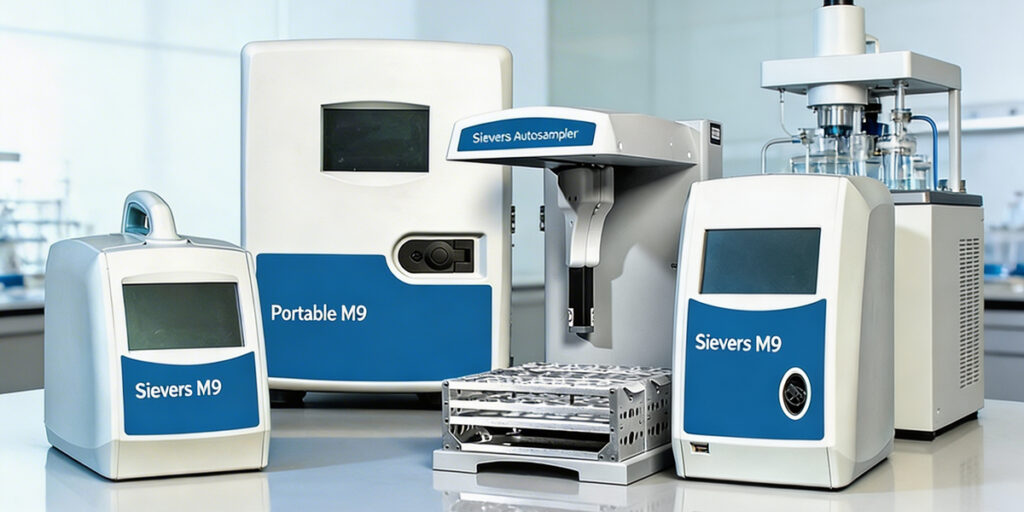
The Sievers M9 was not designed for a research scientist with unlimited time. It was designed for the QC technician who needs to verify that a vessel is clean, release the equipment and get back to supporting production. That distinction matters.
The Sievers Membrane Conductometric Detection method is what sets the M9 apart technically. Unlike instruments that use non-dispersive infrared (NDIR) detection, the Sievers gas-permeable membrane selectively passes only the CO₂ produced from the oxidation of organics. Acids, bases and halogenated compounds, which are frequently present in pharmaceutical cleaning processes, are prevented from interfering with the measurement. This delivers selectivity and precision in exactly the sample matrices where cleaning validation is performed.
The M9 comes in three configurations to match any deployment need:
Across all three configurations, the M9 delivers a measurement range of 0.03 ppb to 50 ppm with precision below 1% RSD and accuracy of plus or minus 2% or plus or minus 0.5 ppb, whichever is greater. Calibration is typically stable for 12 months. Maintenance requires just a few hours per year. The instrument comes pre-calibrated from the factory and can be prepared for analysis in under one hour.
For regulated environments, the optional DataGuard software provides full 21 CFR Part 11 and Annex 11 compliance, with a secured audit trail, user-level access controls and data that cannot be modified or deleted. The M9 also simultaneously reports TOC, inorganic carbon and conductivity from a single sample, giving three discrete data points that can be used together to identify root cause, optimise cleaning cycles and support OOS investigations.
The most common story Chemetrix hears is some version of this: “We tried TOC. It did not work for us.” After closer investigation, the story is almost always the same. The water baseline was not controlled. The worst-case compound had not been properly identified. The limit had not been correctly translated from ppm of compound to a TOC concentration. The sampling was inconsistent between analysts.
The instrument was fine. The workflow was not.
Chemetrix does not just supply a Sievers M9 and move on. The partnership Chemetrix offers is built around making sure the workflow is right before the instrument is even switched on, and that the team running it has the knowledge to trust the results it produces.
This means three specific things in practice:
When results are consistent, compliance follows. That is not a slogan. It is the operating principle of a cleaning validation programme that works.
Cleaning validation does not have to be the bottleneck it has become in many facilities. The science is straightforward. The regulatory acceptance is well established. The instrument is reliable, automated and designed for QC technicians rather than research scientists.
The three things to take away from this article:
The Sievers M9 delivers consistent, defensible proof that cleaning works. Chemetrix makes sure your workflow does too.
📩 Contact the Chemetrix team to book a cleaning validation workflow audit or arrange a Sievers M9 demonstration: chemetrix.co.za

Chemetrix Export (Pty) Limited
400 - 16th Road
Block H Central Park
Midrand 1685


