

Every food safety lab running aflatoxin testing has faced the same budget conversation: the regulatory sensitivity limit is non-negotiable, but the instrumentation needed to reliably hit it keeps creeping toward LC-TQ territory. Aflatoxins B1, B2, G1, and G2 are some of the most tightly regulated mycotoxins in the food and feed industry, and getting a defensible result at single-digit parts-per-billion levels has traditionally forced a choice between two expensive paths: a triple-quadrupole mass spectrometer, or a fluorescence detector bolted to hardware-intensive post-column derivatisation.
This matters because that choice isn’t really about sensitivity. It’s about whether your lab’s capital budget and sample throughput get held hostage by a workflow that’s more complex than the chemistry actually requires.
Aflatoxin B1 and G1 carry an unsaturated double bond in their structure that suppresses their natural fluorescent response under standard excitation conditions. Historically, labs got around this with post-column derivatisation, either electrochemical bromination or a dedicated photochemical UV reactor placed after the column, to chemically modify the molecule and boost its fluorescence enough to meet regulatory detection limits.
The problem is that this fix adds an entire extra subsystem to the LC pathway. Bromination cells and UV derivatisation lines mean more hardware to maintain, more failure points, and a meaningfully longer time-to-result on every single run, all to compensate for a sensitivity gap that newer detector technology has largely closed.

Sensitivity gets all the attention in budget discussions, but the operational failure mode that actually trips up most testing benches is carry-over. Aflatoxins are notoriously prone to adhering to surfaces within the LC flow path, particularly the sample loop and injection needle. Skip a rigorous washing step between injections, and trace residue from a high-concentration sample bleeds into the next run.
The result is a phantom peak, a signal that looks like a positive detection but is actually contamination from the previous injection. In a regulatory context, this isn’t a minor technical glitch. A false positive can trigger an unnecessary recall investigation; a false negative from masked carry-over can let a genuinely contaminated batch through. Getting the washing protocol right for both the sample loop and the needle isn’t a nice-to-have, it’s the detail that determines whether your data is defensible.
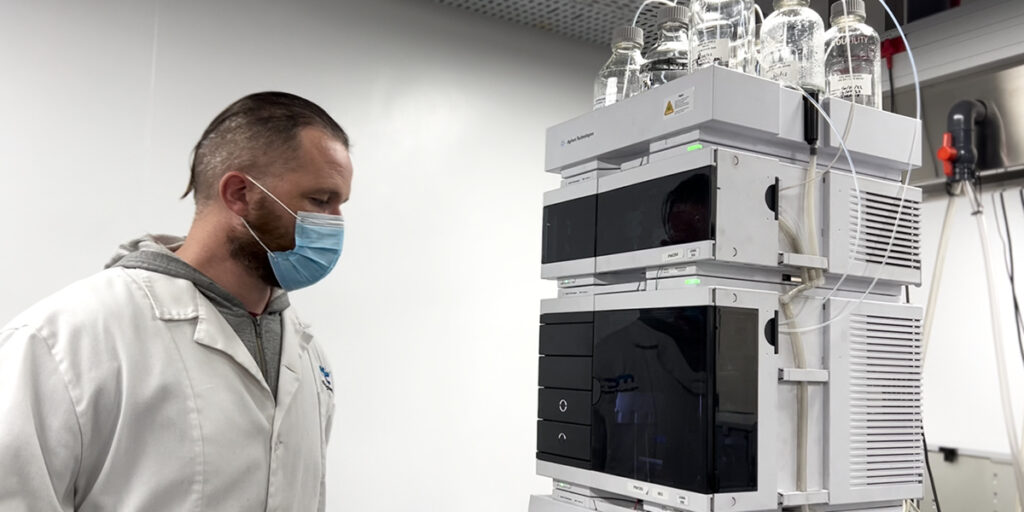
A high-sensitivity UHPLC fluorescence detector changes the equation by addressing the sensitivity gap directly at the optical level instead of compensating for it with extra hardware downstream. A low-dispersion flow cell with a small internal volume keeps the analyte band tight as it passes through the detector, maximising peak height and signal-to-noise ratio without diluting the response across a larger cell volume.
That’s the mechanism that allows a fluorescence detector to reach single-digit ppb limits for all four aflatoxins without derivatisation. No bromination cell, no UV reactor, no second subsystem to validate and maintain, just a cleaner, simpler optical pathway doing the sensitivity work that used to require additional chemistry.
For commercial food testing facilities across Southern and East Africa running routine aflatoxin screening on grain, nuts, and animal feed, the case for skipping derivatisation isn’t theoretical, it’s a direct line to lower cost per sample and less unplanned downtime. Every derivatisation subsystem removed from the workflow is one less component that can fail mid-run and stall a queue of regulatory samples.
The Agilent 1290 Infinity III FLD, featuring an ultra-sensitive, low-dispersion 1.3 µL flow cell, is built specifically for this kind of high-throughput screening, hitting regulatory sensitivity thresholds without the hardware complexity of bromination or photochemical derivatisation.
📚 For labs evaluating whether their current detection limits hold up, the Agilent 1290 Infinity III FLD Aflatoxins Application Note (5994-8938EN) lays out the validated method conditions in full.
Even the best detector can’t compensate for a contaminated flow path. For labs handling high sample volumes, particularly where aflatoxin concentrations vary widely between consecutive injections, a documented, rigorous washing protocol for the sample loop and injection needle should be treated as a core part of method validation, not an afterthought buried in a maintenance schedule.
Chemetrix application specialists work directly with regional labs to audit current wash-step protocols against the matrix and concentration ranges actually being tested, helping teams catch carry-over risk before it shows up as an inexplicable result during an audit. This is the kind of method-level detail that separates a workflow that’s merely fast from one that’s actually defensible.
No. There’s a quiet assumption in a lot of food safety labs that hitting trace-level sensitivity requirements simply requires more hardware, more steps, and a bigger budget. That assumption made sense when fluorescence detectors needed derivatisation to get there. It doesn’t hold anymore.
If your lab is running, or considering, post-column derivatisation to hit aflatoxin sensitivity limits, it’s worth auditing whether that complexity is still necessary. A high-sensitivity UHPLC fluorescence detector can reach the same regulatory thresholds directly, while rigorous sample loop and needle washing protocols remain the real safeguard against false positives and phantom peaks.
Reaching single-digit ppb sensitivity for aflatoxins B1, B2, G1, and G2 has traditionally meant either buying an expensive LC-TQ system or adding complex post-column derivatisation hardware. A high-sensitivity UHPLC fluorescence detector skips both, hitting regulatory sensitivity limits directly. The biggest operational risk isn’t sensitivity at all, it’s column and injection-system carry-over, which causes phantom peaks and false positives if sample loop and needle washing protocols are neglected.

Chemetrix Export (Pty) Limited
400 - 16th Road
Block H Central Park
Midrand 1685


